
Sex doll joint maintenance comes down to three habits. Lubricate each joint every 2 to 6 months with a grease your manufacturer approves. Never push a limb past its natural range of motion. Store your doll flat on its back.
Table of Contents
The full routine takes 15 to 20 minutes. It stops the squeaks and floppy arms that make a doll hard to pose. Done on schedule, it keeps the metal skeleton moving smoothly for years.
Most joint damage starts with a well-meant fix. Extra grease will not tighten a loose joint. The wrong oil can also break down the TPE around a joint. Both mistakes are easy to avoid once you know your skeleton.
At SweetieDoll, we keep joint care simple: identify your skeleton, match the lubricant to your doll’s material, and never force a limb. The sections below follow that order.
Which Sex Doll Joint and Skeleton Type Do You Have?
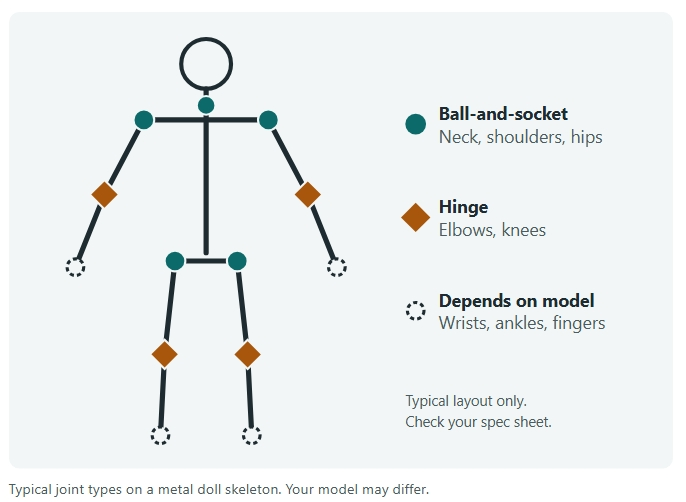
Most full-size dolls use a metal skeleton with ball-and-socket joints at the shoulders and hips and hinge joints at the knees and elbows, and knowing your version tells you how far each limb can move and how often it needs care.
| Joint type | Typical location | How it moves | Care focus |
|---|---|---|---|
| Hinge joint | Elbows, knees | Bends in one plane and does not rotate along the limb[4] | Keep it clean. Never bend it backward. |
| Ball-and-socket joint | Shoulders, hips, neck | Rotates in several directions | Lubricate the socket. Watch the range of motion, because the joint itself does not stop at a natural limit.[4] |
| Friction disc joint | Varies by model | Holds its position through friction | Loses joint tension, the friction that holds a pose, over time. Tightening is usually a seller-level fix. |
Manufacturers commonly build the frame from stainless steel or aluminum alloy. The joints are the moving parts, so they need regular care.
Standard vs. Upgraded (EVO-Style) Skeletons: What Changes for Care
A standard skeleton bends the elbows and knees about 90 degrees and cannot shrug the shoulders. An EVO skeleton is an upgraded frame that adds shrugging shoulders and a spine that leans left and right.
Sellers use the EVO label loosely, so features differ by brand. A common misunderstanding is that every skeleton can shrug. Standard frames cannot, and forcing the motion strains the joint. Extra movement also means extra joints to lubricate and inspect.
Why the Skin Material Sets the Real Limit
The metal frame can often move farther than the material around it. TPE (thermoplastic elastomer) is soft and stretchy. Silicone is firmer and holds its shape. Some dolls are hybrids, with a silicone head on a TPE body, so check each part.
The skin folds and stretches at every joint. Push past that stretch and you risk tearing the skin near the joint. If you are still choosing a doll, browse our silicone dolls with movable-joint skeletons and check the skeleton details before you order.
Grease, PTFE, or Nothing? Matching Your Lubricant to TPE or Silicone
For most metal doll skeletons, a rice-grain dab of mechanical silicone grease on each major joint, applied every 2 to 6 months depending on use, keeps movement smooth, provided your manufacturer confirms it suits your doll’s TPE or silicone skin.
Mechanical Silicone Grease vs. PTFE vs. Personal Lubricant
Mechanical silicone grease is silicone oil blended with a thickener and made for moving parts.[1] A PTFE hybrid, which adds slick PTFE powder to the blend, is the usual second choice. Personal lubricant is a different product. Water-based formulas wash off or evaporate, so they cannot protect a metal joint.
Online advice conflicts here, so use one rule: follow your manufacturer first. Silicone grease is common on rubber O-rings, yet reference works list it as a poor match for silicone rubber itself.[1] Some guides also suggest white lithium grease. It is petroleum-based, so treat it like the products in the next list unless your manufacturer approves it.
Before you use any new grease, test a tiny dab on a hidden patch of skin for 24 hours.
Five Products to Keep Off Your Doll’s Joints
Soft TPE relies on plasticizer oil, also called processing oil, for its softness. One patent for super-soft TPE gels reports oil loads of 85 to 91 percent by weight.[2] Commercial TPE formulas also vary widely between manufacturers,[3] so treat every outside oil as a risk.
- WD-40: A petroleum-based spray that evaporates and can soften some plastics and rubbers.
- Petroleum jelly: Care guides warn that it degrades TPE.
- Cooking oil: It turns rancid and gums up moving parts.
- Motor oil: It is thin and dirty, and it can stain skin.
- Water-based lubricant: It dries or washes out and leaves the metal unprotected.
How to Lubricate a Doll Joint in 4 Steps
You need approved grease, cotton swabs, and a microfiber cloth. Allow 15 to 20 minutes.
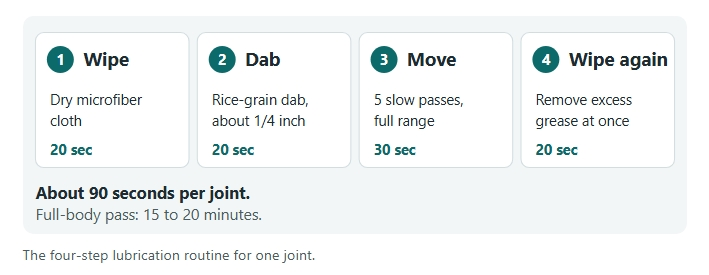
- Wipe: Clean the joint area with a dry microfiber cloth (20 seconds).
- Dab: Touch a rice-grain dab of grease, about 1/4 inch long, to the joint with a cotton swab (20 seconds). Use half a grain on the neck.
- Move: Work the joint slowly through its full range of motion 5 times (30 seconds).
- Wipe again: Remove excess grease before it reaches the skin (20 seconds).
Treat the shoulders, elbows, hips, and knees as major joints. Each joint takes about 90 seconds, so a full-body pass takes 15 to 20 minutes. Reach each joint the way your manual describes. If the manual is silent, ask support before you start.
How Much and How Often: A Usage-Based Schedule
| Usage level | What it looks like | Lubricate every |
|---|---|---|
| Light | Posed a few times a month | 6 months |
| Moderate | Posed about once a week | 4 months |
| Heavy | Posed most days | 2 to 3 months |
Care guides commonly suggest these intervals, and your manual overrides them. If a joint squeaks before its date, lubricate that joint early. New dolls often squeak or feel stiff during the first 2 to 3 weeks, and that is common. Give the skin time to settle before you reach for grease.
The bottom line is simple: match the grease to the material, keep each dab to a rice grain, and stop when in doubt.
Not sure your doll’s material suits a grease? Ask our support team before you apply anything.
How Much Range of Motion Can Each Limb Safely Take?
Every joint has a built-in stop, and pushing past it loosens the joint.
- Hips: Straighten the leg, then rotate the hip in small steps.
- Knees and elbows: Bend forward only. A standard skeleton stops at about 90 degrees.
- Shoulders: Raise the arms in a smooth arc. Skip the shrug unless your skeleton supports shrugging shoulders.
- Spine: Support the lower back and upper chest with your hands when you bend the torso.
- Neck joint: Tilt the head slowly, and never twist it hard to one side.
- Fingers and toes: Curl them forward only.
Hips First, Knees Second: The Leverage Rule
Position the hip while the knee is still straight, then bend the knee. A bent knee turns the lower leg into a long lever, and that lever strains the hip joint. The most common posing mistake is bending the knee first and twisting the hip second.
Why the Spine and Neck Resist on Purpose
The spine and neck joint feel tighter than the limbs because they hold up the torso and head. A doll patent notes that ball-and-socket joints in a backbone can allow contortions no human body can make, which is why some designs limit spine movement.[4] Treat the resistance as a feature. When you bend the torso, keep one hand on the lower back and one on the upper chest.
No Hyperextension: Knees, Fingers, and Lifting Safely
Hyperextension means bending a joint backward past straight. Knees and fingers are not built for it. When you lift your doll, support the upper and lower body together, and return the arms to the sides afterward.
The 30-Minute Arm-Hold Check
The arm-hold check gives you a number you can track. Prop your doll upright against a wall. Raise one arm to shoulder height with the elbow straight, and mark the wrist position on the wall with painter’s tape. After 30 minutes, measure how far the wrist dropped, in inches.
Repeat the check before lubrication, one day after, and after 30 days of storage. Log the date, the room temperature in °F, and each result. A drop that grows over time points to a loosening joint, which the diagnosis table in the last section helps you sort out.
Which Storage Position Keeps Joint Tension for Years?
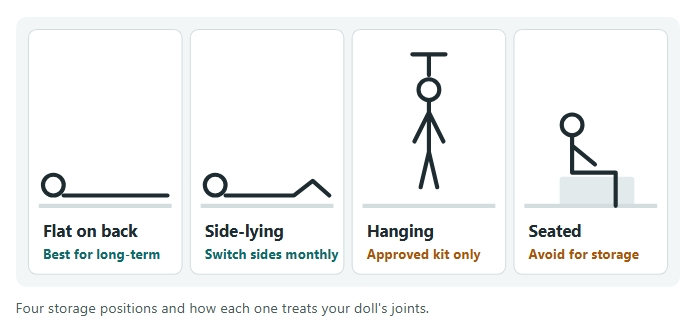
The safest long-term storage position is a neutral pose, flat on the back with arms at the sides and legs straight, because it puts the least sustained load on the hip, knee, and shoulder joints and protects your doll’s joint tension.
Neutral Supine vs. Hanging vs. Seated Storage
| Position | Joint stress | Best for | Watch out |
|---|---|---|---|
| Flat on back | Lowest sustained load | Any long-term storage | Keep the limbs straight and the arms at the sides. |
| Side-lying | Low. The lower arm and hip carry the weight. | Closets too narrow for flat storage | Switch sides every 30 days. |
| Hanging | Concentrated at the attachment point | Tall closets | Use only a hanging kit your manufacturer approves. |
| Seated | Highest. The hips and knees carry the load for hours. | Short display sessions | Never use it for storage. |
Monthly Rotation and Room Conditions
If you store your doll side-lying, switch sides every 30 days so neither hip carries the load for long. Leaving a doll seated for weeks keeps the hips and knees loaded the whole time, and that load can loosen them.
Keep the storage room at a steady temperature, within the range in your manual. Avoid attics and car trunks, where heat swings are largest. Before a fall move or a long trip, return every limb to a neutral pose first.
Squeak, Stiffness, or Looseness: Who Should Fix It?
A squeak usually means dry friction that lubrication can fix, grinding points to metal-on-metal contact that needs a closer look, and a limb that swings freely means a loose joint whose skeleton hardware needs to be tightened, not more grease.
| What you notice | Likely cause | First action | Who fixes it |
|---|---|---|---|
| High-pitched squeak | Dry friction at a metal joint | Lubricate that joint with approved grease. | You |
| Stiff joints in weeks 1 to 3 | Skin settling around the skeleton | Wait 2 to 3 weeks, unless your manual says otherwise. | You |
| Squeak returns within days | A cause other than dry friction | Stop moving the joint and contact your seller. | Seller |
| Grinding or gritty feel | Metal-on-metal contact or debris | Stop moving the joint and inspect it gently. | Seller, or you if the manual allows |
| Limb swings freely and will not hold a pose | Loose skeleton hardware | Do not add grease. Check your warranty. | Seller first |
| Head droops or wobbles | Loose head connector | Adjust it with an Allen key only if your manual says so. | You, following the manual |
What DIY Tightening Involves, and Why Most Owners Should Not Do It
To tighten a loose joint, you open a seam in the skin, reach the joint hardware, and turn the bolt with a screwdriver or wrench. You then seal the seam with TPE glue, which needs at least 24 hours to cure. Over-tightening can damage the joint, so stop when it feels secure.
The most common repair mistake is adding grease to a loose joint. Grease cannot restore joint tension. Only tighter hardware can.
Warranty Questions to Ask Before You Open a Seam
This is a significant investment, so check your warranty terms before you open any seam. Ask your seller these three questions first:
- Does opening a seam void my coverage?
- How long is the skeleton warranty?
- Who pays for shipping and repair?
Safety note: Opening a seam involves a sharp blade and may affect warranty coverage. If you are unsure, contact your seller first.
Sex Doll Joint Maintenance FAQ
Can I use personal lubricant on my doll’s joints?
No. Personal lubricants are water-based or made for skin, and they wash off or evaporate. They will not protect a metal joint. Use a mechanical silicone grease that your manufacturer approves.
Is it normal for a new doll’s joints to squeak or feel stiff?
Yes. Many new dolls squeak or feel stiff for the first 2 to 3 weeks while the skin settles around the skeleton. If a squeak lasts longer, lubricate the affected joint.
Does lubrication fix loose joints?
No. A limb that will not hold a pose usually has loose skeleton hardware, and extra grease can make it worse. Contact your seller about adjustment before you open any seam.
Can a sex doll skeleton be tightened or replaced?
It depends on the model. Some joints can be tightened or replaced, and others need factory service. Contact our support team with your model name and a short video of the joint, and we will point you to the safest next step.
In summary, sex doll joint maintenance is a 15-to-20-minute habit. Lubricate on schedule with an approved grease, pose each limb within its range, and store the doll flat. The key takeaway: fix friction with grease and looseness with hardware, and ask before you open a seam.
Joint feeling loose?
Contact us before you open a seam, so your warranty stays intact.Contact SweetieDoll support
Sources and Editorial Notes
How We Wrote This Guide
We compared published care guides from doll retailers, then checked material and joint claims against patent records and a peer-reviewed study. Where sources disagree, this guide tells you to follow your manufacturer. We have not run lab tests for this version. The 30-minute arm-hold check is a method you can run yourself, and your own log is the evidence that counts.
References
- Silicone grease and rubber: Explains what silicone grease is and why it suits rubber O-rings but not silicone rubber. Wikipedia: Silicone grease
- Oil in soft TPE compounds: A patent describing styrenic TPE built with paraffinic plasticizer oil at 85 to 91 percent by weight. EP2566920A2, Super-soft thermoplastic elastomers
- TPE formulas vary by maker: A peer-reviewed study of commercial polyolefinic TPEs from different manufacturers, with hardness from Shore A45 to D51. Montoya et al., European Polymer Journal, 2004 (CONICET repository)
- Doll joint mechanics: A patent on hinge and ball-and-socket doll joints and their natural range of motion. US6929527B1, Doll and infrastructure therein